
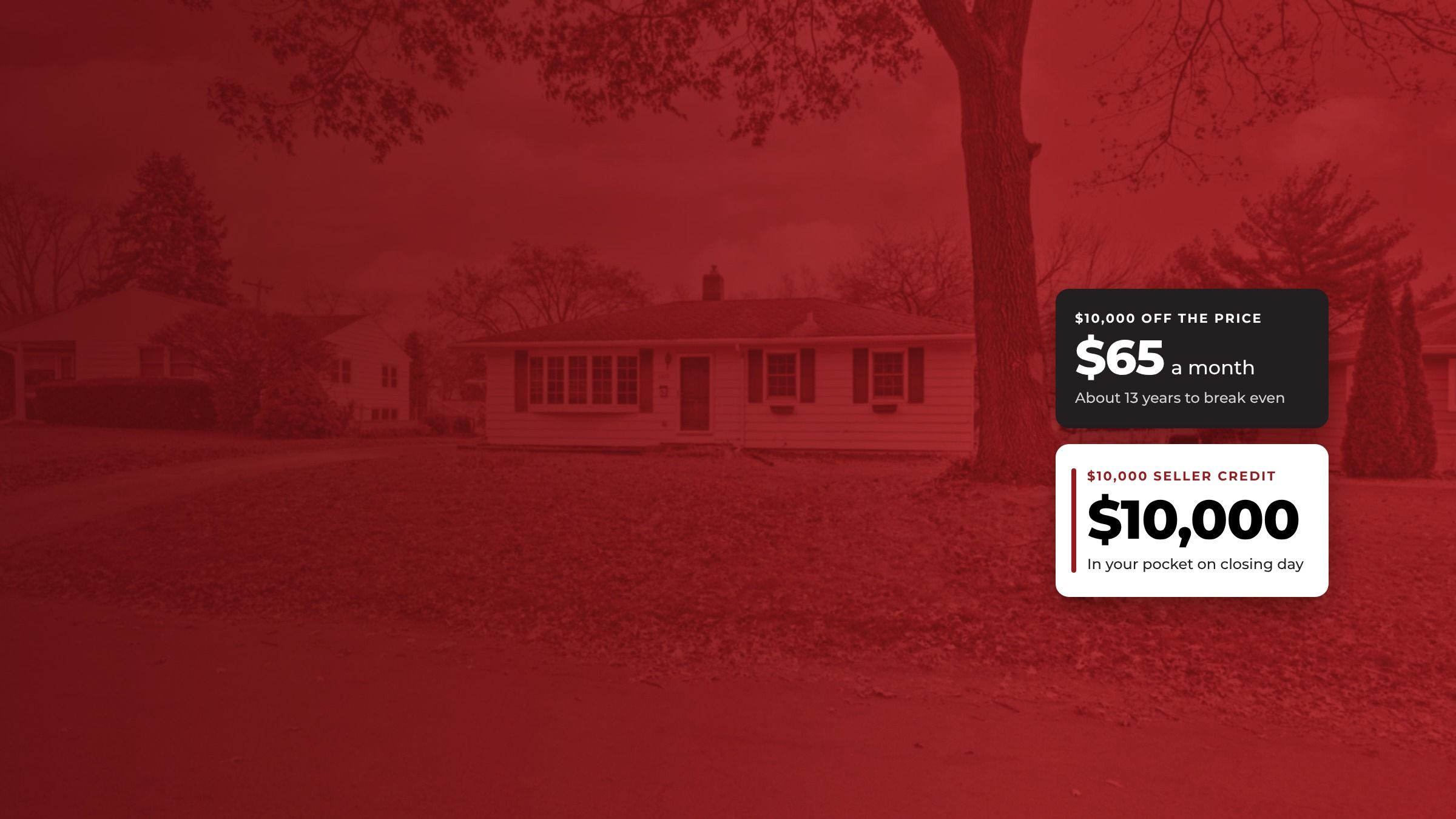

That $10,000 price drop you fought for? It saves you about $65 a month.
That's it. To get $10,000 back at $65 a month, you'd need 153 months. That's nearly 13 years.
Most buyers think getting the seller to drop the price is the win. I've sat across the closing table from hundreds of buyers, and it's actually the worst move you can make. Here's why, and what to ask for instead.
The math nobody runs before they write the offer
Say you're buying a $550,000 home. You've got two options.
Option A: Negotiate the price down $10,000. You pay $540,000.
Option B: Ask the seller for a $10,000 credit toward your closing costs instead.
Same $10,000 from the seller. Completely different outcome for you.
With Option A, that $10,000 comes off your loan. On a 30-year mortgage, it lowers your payment by about $65 a month. You don't feel it on day one. You feel it a little bit at a time, for years.
With Option B, the $10,000 is in your pocket on closing day. It covers money you'd otherwise bring to the table in cash.
Why you'll probably never break even on a price cut
Here's the problem. The average homeowner sells or refinances every 5 to 7 years.
So if a price cut takes 13 years to pay you back, and you're likely to sell or refinance in 5 to 7, you'll never even reach that break-even point. You gave up a real $10,000 today for a slow drip you'll probably never finish collecting.
That's why wealthy buyers don't negotiate the price. They negotiate the terms.
3 things to ask for instead of a price cut
1. A seller credit toward your closing costs
Take the same $10,000 as a credit at closing instead of off the price. It's cash you keep on day one, not $65 a month spread across 153 months.
2. A rate buydown
Have the seller pay to buy down your interest rate. The rate drives your monthly payment, so seller money spent here usually lowers the payment more than the same money off the price. And the savings start with your very first payment.
3. Seller-paid repairs or a home warranty
Have the seller fix what the inspection found before closing, or pay for a one-year home warranty. Either way, costs that would've come straight out of your pocket after move-in are handled before you get the keys.
Free guide: 3 Things to Ask for Instead of a Price Cut
I put all of this on one page you can keep on your phone when you write an offer: the math, the three asks, and the exact wording to put in your offer for each one.
Download the free guide (PDF) →
This is the exact strategy I walk my own clients through before they make an offer.
Which one is right for you?
It depends on your loan, how much cash you're bringing to closing, and what the seller needs. Lenders also cap how much a seller can credit you, and that cap changes with your down payment and loan type. A seller credit also can't be more than your actual closing costs.
That's why this conversation should happen before you write the offer, not after.
Thinking about buying in Madison, Middleton, or anywhere in Dane County? Talk to Dan Chin Homes before you write your offer, so the terms work as hard as the price. Call or text (608) 620-4177.
Quick answers
Is it better to ask for a lower price or a seller credit?
For most buyers, a seller credit wins. A $10,000 price cut lowers a 30-year mortgage payment by only about $65 a month, which takes about 153 months (nearly 13 years) to add back up to $10,000. A $10,000 seller credit lowers your closing costs right away.
How much does a $10,000 price reduction save on a mortgage?
At recent 30-year fixed rates, about $65 a month. The exact amount depends on your interest rate and loan terms.
Why don't price cuts pay off for most buyers?
The average homeowner sells or refinances within 5 to 7 years. A price cut that takes nearly 13 years to pay back usually never breaks even before the loan is gone.
What can a buyer ask for instead of a lower price?
Three common options: a seller credit toward closing costs, a seller-paid rate buydown, or seller-paid repairs or a home warranty.
Is there a limit on seller credits?
Yes. Lenders cap seller concessions based on your loan type and down payment, and the credit can't be more than your actual closing costs. Ask your lender for your limit before you write the offer.
Illustrative example only: a $10,000 difference on a 30-year fixed loan at about 6.9% works out to roughly $65 a month. Your numbers will vary with your loan, rate, and lender limits on seller credits and buydowns. This article is general information, not financial or legal advice.
Questions about buying or selling in South Central Wisconsin? Let's talk it through.